



In the celebrations of the local church in the Philippines, the Month of May cannot be denied as a jewel when it comes to the celebration dedicated to honoring the Blessed Virgin Mary although it is overshadowed by the greatness of the Feast of the Resurrection of the Lord Jesus Christ. That's why the month of May features in the nickname as 'Mary's month

Historically, the Month of May has a beauty that fascinates people. Even before the time of the dominance of Catholicism in Europe and neighboring areas, the pagans have been celebrating this month with enthusiasm and a look of hope, as the first day of May is characterized as the beginning of spring, and banishing the darkness of winter. People offer flowers and agricultural produce to the goddesses as a call to their passion for the beginning of spring.

In the tradition of the Church, the former month cherished by pagan peoples was gradually sanctified by tradition and patronage through the adoption of the Blessed Virgin Mary. The root of this celebration and tradition every May, although it is not certain when it started, gives a deep view of how people gradually got used to it. The celebration of the Month of May will be rooted in the honoring and devotion of the believers to the 'Passion of the Lord Jesus Christ', particularly the tool of his suffering the 'Cross'. That's why alongside the celebration of 'Flores de Mayo' is the feature dramatization and strong devotion 'Santa Cruzan sa Mayo'. Such a practice was recognized in the 14th century, particularly in the work of the Dominican Beato Henry Seuse (1366) in his devotional work 'Spiritual May'. Such a tradition spread in the Dioceses of Germany and neighboring areas from the 14th to the 18th century.

Along with the growth of devotion to Santa Cruz, is the revival and growth of devotion to the Blessed Virgin Mary. So denying a month for the Blessed Virgin is no different in the Church just like the work of 'Tricesimum' (30 days devotion to Mary) which is usually performed every August 15th to September 14th. Distinguishing the month of May as the Month of Mary can be considered a natural living experience of people. This practice is said to have originated as private devotionals with collected records in 1739 at Grezzano near Verona. In 1747, the Archbishop of Genoa featured this work as devotion in homes, until May 1784 when this May devotion was performed publicly in the Church of the Camillians in Ferrara, and in Rome in 1813. It became more prominent and spread this tradition when this work every May was recognized by Pope Pius VII and granted an indulgence in 1818. When this work was in France and Italy and became part of the exercise in Jesuit seminaries, the more widespread and stable it was this devotion that first came to life in homes.

Here in the Philippines, the celebration of the Month of May as the Month of Mary is rooted in the two priests who caused this land to begin in the east. The priests Msgr. Mariano Villena Sevilla and Fray Raymundo Lozano Mejia, O.S.A. and their works are almost not far apart in age, but the same office, it is the honoring of the Blessed Virgin Mary.

Fray Raymundo Lozano Mejia's work "Diario de Maria" printed in Bisaya and Spanish in 1855, Mes de Maria in 1865, and Flores by Maria Santisima in 1867 gave the initial seed of Flores de Mayo and celebration of the Moon of Maria in the region of Iloilo and neighboring areas.

In the province of Bulacan or we can also say in the entire Katagalugan, the Bulakenyo priest Mariano Sevilla who is a native of Bulakan Bulacan can be considered the pioneer in this work. What he started was adapted and inspired from the writings of Father Alfonso Muzzarelli, S.J. in 1785 "Il Mese di Maria, osia di Maggio Consacrato a Maria S.S." While Father Mariano Sevilla was in charge of the Parish of San Juan de Dios in Hacienda de Buenavista (San Rafael Bulacan), he began the translation of Father Muzzarelli's Italian work into Spanish entitled La Flores de Maria (1864-1865). This work became more prominent when he translated it into Tagalog and printed it under the title Flores de Maria or Mariquit na Bulaclac which during the Meditation for the Full Month of May is Offered to Manga Devoto cay Maria Santisima in 1867. This initiative of Father Mariano Sevilla gave prominence to this work every May with the recognition 'Flores de Maria' or 'Flores de Mayo' sa Pilipinas. This act of honoring the Blessed Mother was given more shine with the many blessings granted to those who will perform it, especially in 1854 with the announcement of the Dogma of the Immaculate Conception that in May one year after the declaration in Rome this news was announced to the Dioceses especially in the Philippines. Likewise, Pope Pius IX in 1859 granted the Plenary Induction to those who will perform this holy practice of Flores de Maria.

At present, the Flores de Maria is very different, which has been adapted to the current era in the original and true method of Flores by Father Mariano Sevilla. Flores de Maria is a month of devotion to the Blessed Virgin and dedication to her. It is accompanied by prayers, meditation, praying the litany, performing acts of piety and offering flowers. Wandering was not part of the Flores method, it was only added in later years as an integration of the tradition of Sta. Cruzan and Flores de Maria. The first Flores de Maria or Flores de Mayo in Bulacan was initiated by Father Mariano Sevilla in the Church of his origin, the Parish (and now the Diocesan Shrine) of Nuestra Señora de la Asuncion.

According to the notes of Mr. Mariano Santos, the late local historian of the town and also according to the testimony of the elders, it was first dedicated to the Virgin of Bulakan, its Patroness is Nuestra Señora de la Asuncion. Not later, due to the entry and propagation of the devotion of the Vincentians to the Blessed Virgin of the Medalla Milagrosa, and the growth of the Legions of Mary, the honoring of the Virgin of Asuncion as the Virgin who is offered every Flores, was fulfilled in the image of the Virgin of the Medalla Milgrosa. The Virgin of Medella Milagrosa in Bulakan is the one known by past and present generations as the Virgin of Flores of Bulakan – the Beautiful Sampaga.

The original method of celebrating Flores is very impressive, and really full of devotion to the Blessed Virgin Mary. Since then in the 18th century, it has been known that every time the Month of May comes, the Churches dedicate an altar that they decorate with many flowers, an offering to the Blessed Virgin. Likewise in homes, just like those mentioned earlier that this celebration organically originates in the homes of the devotees. What is unique about the celebration of Flores, which is often lost in the current era, is the performance of sacred activities. It consists of thirty (30) acts of piety to be performed by a devotee with each passing day. Every morning, on the altar at home the devotee will pull out a work of piety that he will try to achieve during the day. In the afternoon, if the person has performed the act of piety for that day, he will go to the church with a flower that symbolizes his piety during the day, he will participate in the piety training, listen to the meditations or for example, and then the flower will be offered at the feet of the Virgin Mary. People who cannot perform the act of piety drawn for the day, cannot offer a flower to the Blessed Virgin, and promise to make an effort to do the act of piety for the next day.

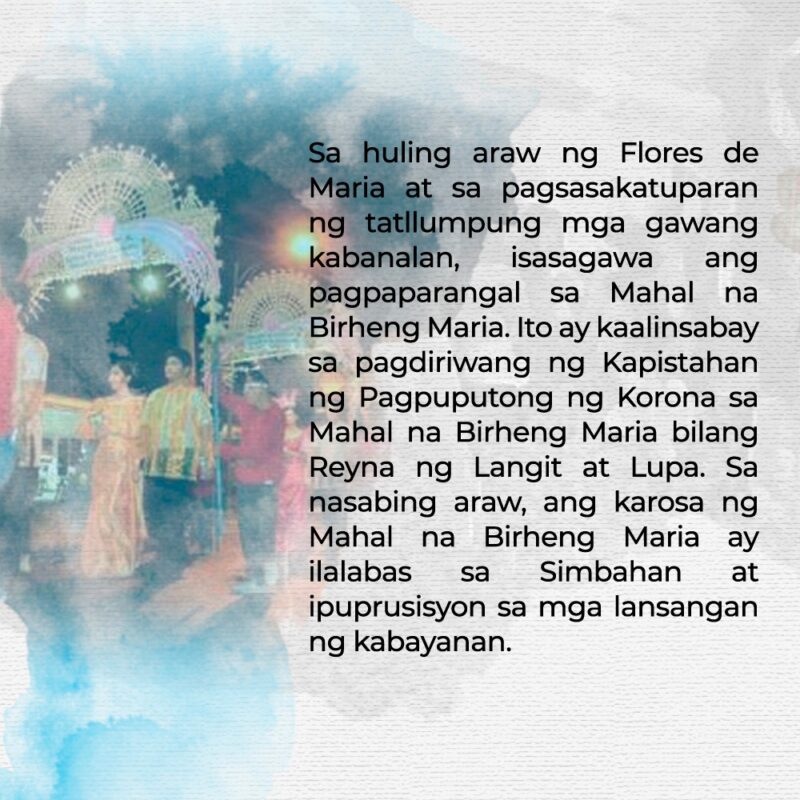
On the last day of Flores de Maria and upon the accomplishment of thirty acts of piety, the honoring of the Blessed Virgin Mary will be performed. It coincides with the celebration of the Feast of the Coronation of the Blessed Virgin Mary as Queen of Heaven and Earth. On the said day, the carriage of the Blessed Virgin Mary will be taken out of the Church and will be paraded through the streets of the town. The carriage is accompanied by women who have performed acts of piety and devotees of the Blessed Virgin called 'Hijas de Maria'. The men who are usually in the carriage and who follow it as if they are supporting the majestic Virgin are called 'Caballero de Maria'. When the procession returns to the Church, it will end with the prayer of the Litany to the Virgin Mary, after which the Curate will perform the blessing by presenting the relic of the Blessed Virgin Mary. This celebration of Flores de Maria, not only in Bulakan but also in the neighboring Towns is really celebrated as a joyful Festival. The people led by the Brothers and Sisters hold games, and programs in the square, as well as playing band music. In the present time, since the Feast of the Queenship of the Blessed Virgin Mary was moved from May 31 to August 22, the celebration of the closing Feast of Flores was also moved from the last day of May to the last week of May. In the present day, the procession with the brides of the carriage of the Blessed Virgin Mary is carried out on this day or night. The women are called sagala, and each sagala bears a title of the Blessed Virgin Mary. At the end of the procession, the procession will end at the Church, offer flowers, and the most prominent procession will be the one that will offer a crown to crown the image of the Blessed Virgin Mary.

Flores de Maria is really wonderful, as a People who love Mary, this celebration is a reflection of our love and devotion to the Great Mother of God. However, the festival is facing many challenges, especially the secularization of festivals, the changing of the flow, the loss of some rich traditions. Despite the trials, let's not lose the true spirit of Flores de Maria in the Month of May, which is dedicating ourselves to following, imitating, and obeying as her Hijas and Caballeros de Maria.

Celebrate Mary, Ave Maria Purisima!

Written by: Alexander M. Villaluz, M.A.S.S. (Cand.), DCSC Research Team

Sources:

Alfonso, Ian Christopher B. Bulakan: Remembering the Grace of the Past. Vol. I: Nature, History and the Parish. Bulakan-Malolos City: Nuestra Señora de la Asunción Parish, Bulacan Research Center and Bulacan State University. 2012.

Alvir, Antonio D., Traditional Miracles of Some Saints in Bulacan. Manila. 1916.

Andrés, Roberto Blanco. "The mission of 1853 to the Philippines. El diario inédito de Raimundo Lozano”, Archivo Agustino, Vol. 103, No. 1 (2019).

Benedictine Sisters of Perpetual Adoration. An Abounding Source of Blessing for the Living and the Dead. France. 2015.

Fernando, Antonio., The Santa Cruz de Mayo in Bulakan Town. Manila. 1915.
Frisk, Jean. May and Mary. University of Dayton. 2016. Retrieved from: https://udayton.edu/imri/mary/m/may-and-mary.php#top.

Kuppers, Kurt. Marienlexikon: The history of May Devotion, Volume 4. Augsburg. 1987.

Muzzarelli, Alfonso, S.J., Il mese di Maria, osìa di Maggio consecrato a Maria S.S. di Padre Alfonso Muzzarelli, sj (rist. anast. Ferrara, 1785). Edited by F. Iodice. Rome: Newman center Tor Vergata, 2013.

Panganiban, Kendrick Ivan B. “The Beginning and Development of the Flores de Mayo Marian Devotion in Bulacán and Contributions of Fr. Mariano Villena Sevilla: A Historico-Theological Study” S.Th.L. Thesis. Pontifical and Royal University of Santo Tomas – Faculty of Sacred Theology, Manila, Philippines, 2022.

Parish of Nuestra Señora de la Asunción – Cofradia de la Nuestra Señora de la Asunción, “Asunción: Fortress of Faith of the Bulakeños”. Unpublished Coffee-Table Book. Bulakan: Parish of Nuestra Señora de la Asunción – Cofradia de la Nuestra Señora de la Asunción, 2020.

Santos, Mariano T., ed. Gunita, 1578-1978: Kay Bathala and the People. Bulakan-Malolos: Parish of Nuestra Señora de la Asuncion and the National Media Production Center – Bulacan Office, 1978.

Seville, Mariano V., ed. El Catolico Filipino. Año I – Año II (June 2, 1861 – June 29, 1862). Pontifical and Royal University of Santo Tomas – Miguel de Benavides Library, Manila, Philippines.

Sevilla, Mariano V. Flores de Maria or Mariquit the Bulaclac that in the Meditation of the Whole Month of May is Offered Devotedly to Maria Santisima. Manila: Establiciemento tipografico de Real Colegio de Santo Tomas, 1888.

Santos, Mariano T. Bulacan Town Book. Plaridel: Plaridel Publications, 2001.

Seuse, Henry, O.P. Horologium Sapientiae. France. 1450.

Photo Courtesy: Zurc Events
