
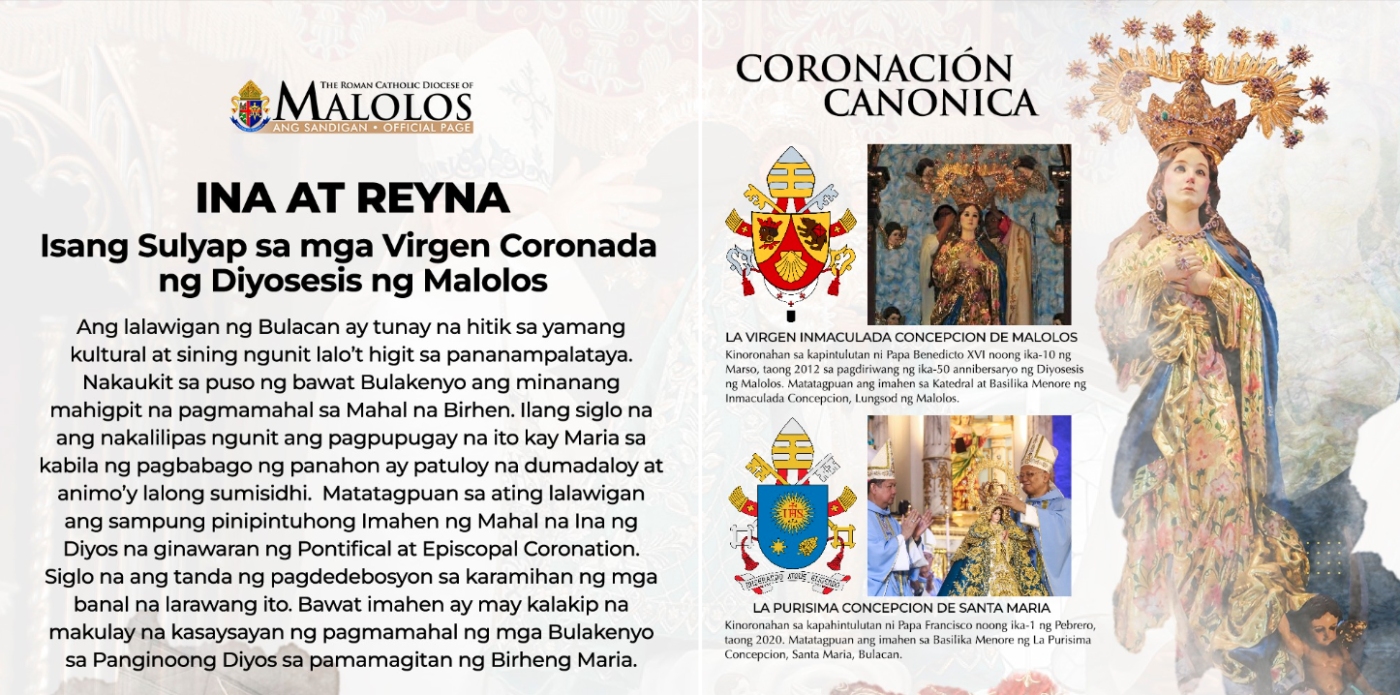

It is said that we Filipinos have a different fascination with Mothers. In fact, our country has been called as “Inang Bayan” (“Motherland”). According to the old proverb, the performance and respect of our ancestors that is awarded to a Mother is intense, so the oldest translation of Ave Maria in Latin is Hail Mary. A recognition that is more than a collective tribute to men or women.
The province of Bulacan is truly rich in cultural and artistic resources but even more so in faith. Engraved in the heart of every Bulakenyo is the inherited strict love for the Blessed Virgin. It was several centuries ago but this tribute to Mary despite the change of time continues to flow and seems to be getting stronger. Our province is home to ten venerated Images of the Blessed Mother of God that have been awarded the Pontifical and Episcopal Coronation. Centuries of devotion mark most of these holy images. Each image has attached a colorful history of the love of the Bulakenyo people to the Lord God through the Virgin Mary.
It is interesting to think that since the introduction of Christianity by the Spanish, the constant and towering standing of these revered images is as if a symbol and also a unique bridge or link from the colorful past. Each of these images can be said to be silent witnesses to every joy, hardship, suffering, and celebration of those who come to the Virgin Mary. It is also no wonder that the country of the Philippines is nicknamed as Pueblo Amante de Maria—The People Who Love Mary. It is an assurance that the unique dedication of the Bulakenyos to the Holy Mother of God truly responds to this and it can be said that the crowned images of the Virgin in the province have been part of creating this unique award from the Pope.
With the arrival of the Augustinian missionaries, our province was placed under the guidance of the Blessed Virgin as Inmaculada Concepcion. This leaning was started by the establishment of the Church of Malolos which is now the Cathedral and Basilica Minor of the Inmaculate Conception. Even the Franciscan Missionaries who brought the Good News designated the towns they founded in La Purisima Concepcion.
Until the present time, the beginnings of these valiant missionaries have been engraved and etched in the hearts of the Bulakenyo people. Our Diocese is also tirelessly continuing to spread the reverent recognition and love for the Mother of God, a true treasure that we keep and can be seen in 10 images that have their own history in our province. Come and let us discover the history of the venerated images of the Blessed Mother:
1. The so-called Miraculous Virgin in the Patio or La Purisima Concepcion de Baliuag is located in the middle of the patio of the Church of San Agustin in the City of Baliuag. The six-foot-tall image was made of cast iron by the company of artisan Jean Jacques Ducel of Paris, France.
The image of La Purisima was worshiped in the Patio between the years 1877-1898. Since the enthronement of the Virgin, it has been a Baliwagenyo custom to pay homage to the Virgin in the Patio by visiting her presence before entering the church. Also before going home, the devotees pass by the Virgin. Through this tradition, so many graces and answers to prayers are granted by the Blessed Virgin that it is not surprising that this custom continues to be practiced today.
Besides fervent prayers and visits to the Virgin, according to surviving records and witness testimonies, in the early years of the 19th century there was found at the feet of the Virgin a flowing pure water. Fuente de La Purisima Concepcion are the words engraved on the marble that used to be placed at the foot of the Templete. This marble is carefully kept today in the parish museum and is a unique memory of the miraculous water well that once filled our town. According to the custom and the translated testimonies of the devotees, countless healings are said to be granted by God through the Virgin Mary from anointing or perhaps drinking the water obtained from her Fountain.
In recognition of this shrine of Mary and gratitude for the blessings received through La Purisima Concepcion de Baliuag, the Blessed Virgin in the Patio along with the recognition of the Baliwagenyo faith, Bishop Dennis C. Villarojo conferred the Episcopal Coronation on February 1, 2021 .
2. The Diocesan Shrine and Parish of Nuestra Señora dela Asuncion is a unique home of many devotions to the Virgin Mary and an image of the Blessed Virgin that captivated the hearts of the people of the town of Bulakan since it was installed in the church altar last year 1578.
Remember the year 1950 when Pope Pius XII proclaimed the Dogma of the Assumption of the Blessed Virgin into Heaven. This is a unique recognition for the people of Bulakan because even before this declaration, the Blessed Virgin was revered in their town as the Virgin of Asuncion.
It is not surprising that 6 years later, while the town is recovering from the destruction caused by the war, one of the important goals of the people of Bulakan is to sculpt the image of the Blessed Virgin of Asuncion as a unique sign of hope and initiation . The image is unique because of her clothing that seems to be being flown by angels towards heaven.
One of the miracles recorded was during the conquest of the English in 1762. According to the translated story, the English wanted to stay in the town of Bulakan but in a rare event they were forced to leave which did not even cause a bloody battle. This event further engraved in the hearts of the people of Bulakan that they are under the protection of the Blessed Virgin. For this reason, a thanksgiving celebration was held by the town to honor the Blessed Virgin for this miracle.
On November 20, 2020, like their ancestors, God’s people sought help from the Blessed Virgin. And under the leadership of Bishop Dennis Villarojo, the Virgin de Asuncion was awarded the Episcopal Crown.
3. The help that devotees receive from praying to the Salus Infirmorum or the Blessed Mother of the Sick is also incomparable. The image is said to be based on an image printed in a World Health Organization magazine. It fascinated and got the extraordinary attention of Fr. Melchor Barcelon immediately ordered Mr. Ricardo Lunod to paint it on canvas measuring 28×38 inches.
The Blessed Virgin became famous for her intercession with the Lord for healing those with physical or spiritual illnesses. Since 1969 when it was enshrined in San Isidro Labrador Parish, Bulakan, the prayers offered by the faithful could not be heard, so it was appropriate for Bishop Villarojo to award it with the Episcopal Crown which is a sign of the fervent prayers of Filipinos who the COVID-19 pandemic will end soon.
The holy rite of Coronation was performed on November 16, 2020.
4. Our province is famous as the one that started paying homage to the Blessed Virgin every May. The month of Flores de Maria is colorful and prepared every May where a Month of Prayer of the Holy Rosary and Dalits to the Queen of Flowers is performed. It ends with the offering of colorful and fragrant flowers for the queen of heaven. There are also beautiful and colorful processions and events.
The sacred image of Nuestra Señora de las Flores is the center of the celebration in the Parish of San Martin of Tours. Before the outbreak of the second world war, the Devotion to the Virgen de las Flores in Bocaue was already popular. The current image was introduced to the people in 1984 under the leadership of Fr. Miguel Paez.
In 2014, in conjunction with the Fluvial Procession of the Dear Cross of Wawa, the liturgical and devotional activities to the Virgin of Bocaue were further enriched.
The beloved image of Nuestra Señora de las Flores was crowned Corona Episcopal on November 16, 2020 by Bishop Dennis Villarojo.
5. In the Barangay of Santo Rosario in the Town of Hagonoy, the majestic image of Nuestra Señora del Santisimo Rosario is respected and respected. This prayer house was founded in the mid-18th century to house the image of the Blessed Virgin of the Holy Rosary. According to the translated story, the beloved Image was seen floating in the Caingin river between 1770 and 1880.
With the number of believers, there was a need to build a big church, so Donya Damasa Crisostomo donated a piece of land to build a bigger church. Year 1947 when sent by Fr. Celestino Rodriguez is Fr. Guillermo Telio to the guest of Sto. Rosario to prepare it to become a Parish. Through Catechisms and holding Lutherans, the faith of the villagers became deeper. The visitor became a full-fledged parish on January 16, 1952 by then Archbishop Gabriel Reyes of the Archdiocese of Manila. Every month of October, the said image is brought to ask for his help and blessings and also to give thanks for the prayers received.
An Episcopal Coronation Decree was signed by Bishop Honesto Ongtioco who is the Administrator of the Diocese on June 29, 2019. Later on October 7th the Coronation was solemnly performed under the leadership of Bishop Villarojo.
6. The radiant image of Nuestra Señora del Carmen known as “Mabunying Impong Carmen” of Our Lady of Mt. Carmel Parish, Pulong Buhangin, Sta. Maria, has deep roots in the devotion to the Scapular brought by Recoleto priests to the Philippines.
Based on parish records, an old woman approached a Barrio named Kunino. He handed Kunino a letter for Simeon and Simeon so that they could build a Chapel. Kunino quickly brought it to the two but they did not believe him and they set fire to the letter.
It is said that the Blessed Mother performed a miracle here for the first time. The letter was not burned and was witnessed by many. Because of this, Simeon and Simeon immediately built the chapel. When the Chapel was built, the woman appeared to Kunino again and he instructed her to go to the Church of San Sebastian in Manila to ask for an image to be installed in the shrine. It is said that on February 9, 1665 when the Image made of ivory with heads and hands and dressed in yellow and chocolate clothing was brought home to Pulong Buhangin. Before the Episcopal Coronation on September 6, 2019, the image was brought to the San Sebastian Cathedral in Manila for a Bihilya, after which it was brought to the Parish of La Purisima Concepcion de Sta Maria and His Parish where he was crowned by the Bishop Villarojo and Ongtioco.
7. One of the so-called apparitions of the Blessed Mother in modern times is her appearance to three young shepherds in Portugal. The National Shrine of Our Lady of Fatima in the City of Valenzuela is home to a special image of the Blessed Virgin better known as the National Pilgrim Image of Our Lady of Fatima.
Devotion to the Blessed Virgin of Fatima began to spread in our country in the 40s through the Blue Army which is now the World Apostolate of Fatima. Of the three images of the Blessed Virgin of Fatima in the National Shrine, two of them were crowned. The first is a symbolic coronation in the image that is already on the altar that was done in the 40’s by Fr. Jose delos Reyes who was crowned on March 16, 1977 by Bishop Cirilo Almario.
The said National Pilgrim of the Virgin who was crowned with a decree is being circulated in different parts of the Philippines to spread the message of the Blessed Virgin. It was also with the people when the so-called “peaceful way of change” took place in 1986 in EDSA.
Since the Parish became a National Shrine on June 12, 1976, it has been the center of celebrations related to the Apparition of the Blessed Virgin.
In 2017, in conjunction with the Catholic Church’s celebration of the 100th Apparition of the Blessed Mother in Fatima, the Episcopal Coronation was again awarded to the Image on May 13, 2017 by Bishop Jose Oliveros.
8. Every May 19th on the last day of the Triduo in honor of San Pascual Baylon and Santa Clara, the honoring of Nuestra Señora de Inmaculada Concepcion de Salambao is held in the town of Obando.
To the accompaniment of pango all the devotees dance their prayers and requests in front of this miraculous image. It is said that the image was “salambab” by three fishermen named Juan, Julian and Diego dela Cruz in Tambobong (now Malabon) on June 19, 1763. When they took the image on a raft, it seemed that what they were riding on became heavy so they decided to go to Obando .
They were very surprised as they quickly crossed the water towards the place that is now the church of San Pascual. Since then the brown image of the Virgin has been displayed in the church still bearing the veil as a reminder of her origin.
Due to the fact that many believers lose their children and success in every challenge in life, Obando is visited by pilgrims from different parts of the archipelago. With countless graces, Bishop Oliveros of the Episcopal Crown awarded the image to the National Shrine of Our Lady of Salambao – San Pascual Baylon Parish on December 12, 2004.
9. One of the most famous images of the Blessed Virgin in exile is the miraculous La Purisima Concepcion de Santa Maria. Along with the cold air and before the arrival of summer, his joyous Festival is celebrated.
The year 1792 is said to be the year of the establishment of the parish and perhaps this is also the year that the devotion to the Miraculous Image of the Blessed Virgin of La Purisima Concepcion began.
It is said that the image came to our country on a galleon from Acapulco, Mexico and was brought to the town by the Franciscan Missionaries. Twice the image disappeared from his shrine. The first was in 1899 where for some inexplicable reason the revered poon could not be found.
It is said that in a dream in 1931 by Mr. Teofilo Ramirez, the Blessed Mother appeared and pointed out where in Gapan, Nueva Ecija, the image is located. When he went to the home where it was kept, the image was indeed there, so it was peacefully brought home to Santa Maria.
In a sad turn of events, the image was lost again in 1999 due to theft. The devotees prayed fervently to ask God for its return. After ten days of prayer and searching the image was found in an antique shop in Malate, Manila.
Once again, the town of Santa Maria celebrated happily and from then on they kept the holy image even more. It cannot be denied that in the midst of prosperity and security enjoyed by the Town of Santa Maria, the Blessed Mother is the beacon and guide.
The Radiant Star of the Province of Bulacan was awarded the Episcopal Coronation on March 3, 2018 by Bishop Oliveros.
While the Pontifical Coronation was granted by Pope Francis. The Holy Mass and Rite was held on February 1, 2020 at the Minor Basilica and Parish of La Purisima Concepcion, Santa Maria.
10. In the heart of our Diocese, the first Coronada image of our Province, La Virgen Inmaculada Concepcion de Malolos, is displayed high. The Mother of the Diocese of Malolos was crowned at the Immaculate Conception Parish Cathedral and Minor Basilica on March 10, 2012 on behalf of Pope Benedict XVI in conjunction with the celebration of the Great Jubilee of the Diocese.
City Festival of the year 1937 of the installation of the image of the Immaculada Concepcion in the main Shrine of the Church. It was created by the sculptor Mr. Teodoro Tantoco Ople from the Barrio of San Vicente and a gift from philanthropist Dr. Luis Santos. The image is reminiscent of Esteban Murillo’s famous painting of the Inmaculada Concepcion.
After the war, the devotion to the Blessed Virgin grew even more and the result of this was the establishment of the Diocese of Malolos on December 11, 1961 during the tenure of Pope John XXIII and he appointed Manuel del Rosario as the first Bishop.
The 10 Crowned Images of the Blessed Virgin of Bulacan are a unique gift of our Diocese to the Mother Church. This inspires the faithful and deep relationship of the Bulakenyos to the Blessed Virgin. In the entire archipelago, it is no coincidence that there are 10 Coronadas in our province. But we must consider that the jewels surrounding and crowning the head of the images will never exceed the Crown that Jesus gave him.
These crowns are a reminder to us and a special bond of the prayers of the People of God heard through the Blessed Mother. Each jewel is a story and history of someone approached God, a healing or a grace received.
The coronation ceremony of the Blessed Mother is also an event that is very beautiful to observe because it is like witnessing our Mother who truly responds to her children who call her. He truly looks out for all who come to him and will never tire of helping at any time or season.
Written by:
Bro. Mark James S. Evangelista, M.A.
DCSC Research Team
References:
De Jesus, Roman, Panayam ng May-akda, Parokya ng San Isidro Labrador, Agosto 4, 2023.
History of the National Shrine of Our Lady of Fatima, Inilathala ng FatimaShrinePH, Hango mula sa https://www.youtube.com/watch?v=PbDJVCdh_Bs noong Agosto 10, 2023.
Jorde, Elviro, Catalogo bio-ibliografico de los Religiosos Agustinos de la Provincia del
Santissimo Nombre de Jesus de Filipinas desde su fundacion hasta nuestros dias. Manila, 1901.
Kasaysayan ng Mahal na Birhen ng Santo Rosario, Inilathala sa Youtube ng Bayang Pinagpala, Hango mula sa https://www.youtube.com/watch?v=Sj494FrIXqk noong Hulyo 20, 2023
La Purisima Concepcion Parish Church, La Purisima Concepcion: Ang Mapaghimalang Birhen, Bulacan, 2020.
Martinez, P.Bernardo, Apuntes históricos de la provincia augustiniana del Santísimo Nombre de Jesús de Filipinas”, año 1909: Filipinas.
Mapa General de las Almas que Administracion los pp Agustinos es estas Islas Filipinas formado el ano 1848, con arreglo a los Mapas de este mismo ano y del de 1847, siendo
Provincial el M.R.P. Julian Martin. Manila. 1848.
Zuniga, Joaquin. M de, O.S.A., Estadismo de las Islas Filipinas o mis viajes por este pais. Ed. W.E.Retana, Madrid, 1893. 2 vols.
#sandiganmalolos #dioceseofmalolos #lascoronadas #coronacioncanonica #coronacionepiscopal #coronationoftheblessedvirginmary
