

Introduction
The citizens of Valenzuela City have known for a long time that the first poblacion of the town was located in Polo, where the first adobe church was built and the pueblo was established in 1623. The Franciscan missionaries, who also built the pueblo of Meycauayan, the same one who founded the town of Polo. San Diego de Alcala placed the entire town under the control of the city, and Polo was ruled by Franciscan friars. So it is surprising that among the elderly visitors and the native parishes of San Diego de Alcala, devotion to the Blessed Virgin of the Holy Rosario spread, a devotion propagated by the Dominican order.
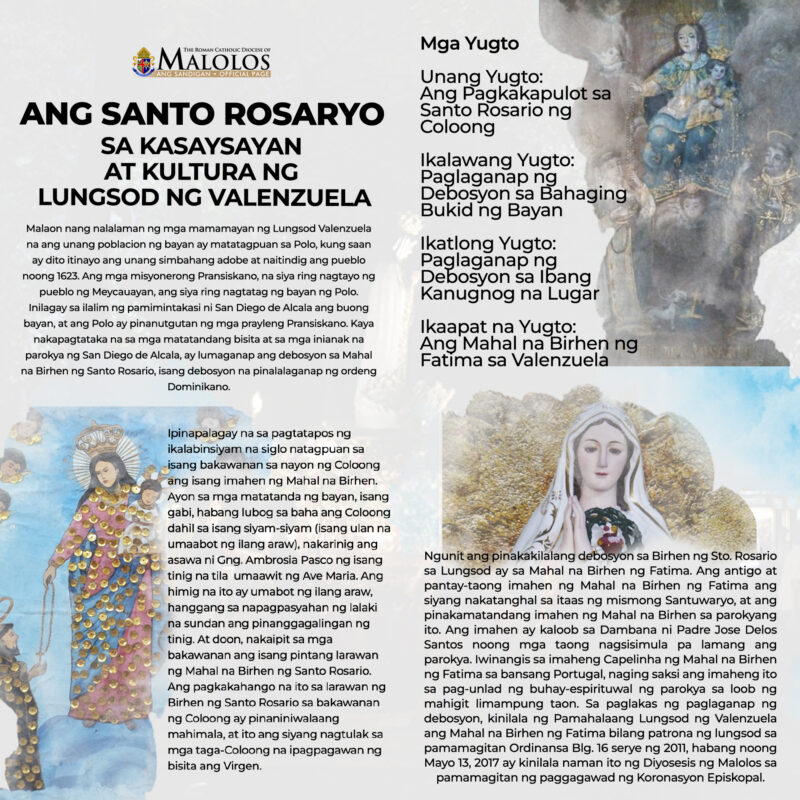
First Stage: The Gathering of the Holy Rosary of Coloong
It is believed that at the end of the nineteenth century an image of the Blessed Virgin was found in a mangrove in the village of Coloong. According to the elders of the town, one night, while Coloong was flooded due to a nine-nine (a rain that lasts for several days), Mrs.’s husband heard. Ambrosia Pasco with a voice that seemed to sing Ave Maria. This melody lasted for several days, until the man decided to follow the source of the voice. And there, stuck in the mangroves is a painted picture of the Blessed Virgin of Santo Rosario. He immediately took the picture and brought it home. From here, its first miracle occurred: it stopped immediately The painted picture shows the Blessed Virgin and Jesus sitting and both handing the Holy Rosary to Santo Domingo de Guzman and San Francisco de Asis, both of whom can be seen on either side of the picture.
This adaptation of the image of the Virgin of Santo Rosario in the Coloong mangrove is believed to be miraculous, and this is what pushed the people of Coloong to make the Virgen their guest. The devotion spread to its neighboring villages such as Tagalag until it reached the parish and other neighboring villages of Coloong. But because of an opportunity to buy and steal the image of the Holy Rosario from his guest, the Pasco family decided to take the image home and take it into the care of Mrs. Ambrosia Pasco. This led the people of Coloong to make a replica of the Blessed Virgin for the visitor. But devotion to the Mother of God continued to flourish under this title.
When the rule of the Franciscan friars ended in the church of San Diego de Alcala, diocesan priests, usually Filipinos, began to take over. Filipino priests started with Rdo. Father Ladislao Santos in 1900/3? until 1906/7. He was followed by Father Esteban Daez. Father Esteban Daez was the first Filipino priest born in Polo who served in the Parish of San Diego de Alcala as parish priest. Father Esteban was instrumental in spreading the culture of Santo Rosario. When he saw that the people of Polo had a growing devotion to the Holy Rosario, he had a carved image of the Holy Rosario made based on the old image of the Virgin of Coloong. Those in the Polo fields, like those in Lawang Bato, come down to join the lutrinas.
Second Stage: Spreading Devotion in the Farm Section of the Town
According to the Historical Data Papers of Karuhatan and testified by the elders of this village, Padre Esteban Daez was the first priest who performed the Holy Mass in Karuhatan after their visitor was built between the years 1910 to 1919. The said also mentions document that the village of Ugong, even before it became a separate parish, also had a visitor where the Sto. Christ and the Virgin of the Holy Rosary became their first patrons. From the very center of the town of Polo, devotion to the Blessed Virgin of the Holy Rosary spread to the rural parts of the town. The devotion has spread to the outskirts of the villages, or farms as they are called, such as Maysan, Karuhatan, Pugad Baboy (now barangay Gen. T. de Leon) and Ugong and even they are performing rituals in their areas. It is also assumed that Father Esteban Daez was the key so that the devotion to Santo Rosario could reach the rural areas of Polo. The devotion of the remote villages or fields to the Mother of the Holy Rosary is what led these villages to build their own tuklongs, or small prayer houses. Later the tradition of talakuk was also brought to these areas. The prayer is a long ceremony of songs and prayers of the Holy Rosary on all days of the month of October. The work is usually led by the elders of the town, and is carried out in the parish and its guests. Taluki is derived from the word taluki, a word found in the final song of the ritual that means a veil or veil that covers the face:
“Queen of heaven, I am farewell Of a star plain to crown Dear mother, I am goodbye Goodbye to you, goodbye goodbye Goodbye and that veil of yours In your glorious appearance And in our sorrowful hearts He also shed tears and sorrow Goodbye my dearest mother God’s temple and sanctuary in heaven With your rosary the town is quiet Take hold of us now who believe.”
The discussion is based on a small book titled “Bouan ng Rosaryo or Bouann ng Oktober”, which was first written in Spanish by Fr. Jose Maria Moran, O.P., which was translated into Tagalog. Those who keep the remaining copies of this book have already translated from their parents, and what can be considered new copies of the said book is still in the year 1956 its fifth and last printing, from the Universidad ng Santo Thomas. Its fifth and last printing was arranged by Fr. Excelso Garcia, O.P. The discussion is led by the elders of the town and accompanied by those who wish to pray, using a book for this. The old tradition of takulaku, apart from the religious aspect (in honor of the Blessed Virgin), is also an opportunity to reunite villagers within the parish or with visitors. Although there are no specific dates, it is believed that in the early years of 1900 devotion to the Holy Rosary reached the rural areas of Polo. It is also assumed during these times that various images of the Holy Rosario were created in the rural areas of Polo, particularly in the villages of Karuhatan, Maysan, Pugad Baboy (now Barangay Gen. T. de Leon) and Ugong.
Different forms of pamintuho were formed in these barangays after they were introduced to devotions in the Holy Rosary. Barangay Ugong is unique because they also have their own painted image of Santo Rosario that resembles the image of Coloong. They are also able to engage in discussion. In barangay Karuhatan, apart from the taluk, the faithful perform the lutrina (a procession that is carried out around the paddy fields to ask for rain or to ask for a bountiful harvest). It can be remembered that the village of Karuhatan was made up of vast rice fields and fields planted with saffron trees (that’s why this place was called kawiatan). Usually the image of the Holy Rosary is what the believers include in their liturgy. In these images of the Holy Rosario in the aforementioned barangays, the division is held. So it is remarkable that these visitors have the same pintakasi, the Mother of the Holy Rosary. Both the old villages mentioned keep ancient images of the Mother of the Holy Rosary, and although these villages have their own festivals, they still celebrate the Holy Rosary every October. Later, Holy Masses began to be celebrated with these visitors, especially on occasions of feasts and certain important gatherings.
Third Stage: Spreading Devotion to Other Neighboring Areas
Since the original honey image of the Santo Rosario is already in the custody of the relatives of those who collected it, the believers of Coloong had to make two replicas of the Santo Rosario which are circulated among the households in the said barangay.
In other areas of the Polo there are still visitors erected featuring the Blessed Mother of the Holy Rosary as patron. In the part of the sitio Malabo in Maysan, an image of the Holy Rosario (which is estimated to have been made at the end of the war) is honored there, especially every October they are also able to hold a prayer there. In the barangay of Mapulang Lupa, there is also a visitor there where the Santo Rosario is also their pintakasi, which is also assumed to have been made in the years after the war. also pointed out to a visitor in Barangay Langka, City of Meycauayan in Bulacan the Holy Rosario together with the Holy Christ. They also celebrate the Month of the Holy Rosary every October where every day of this month they pray the Rosary, and on the last day of October they sing a song similar to the song of the Polo taluki.
Perhaps, at the same time as the devotion to the Holy Rosary came here in Langka, they were also taught to be religious. But with the passage of time and the elders have left, the discussion was not properly translated to the following generations, so the last song is the only remaining trace of this tradition.
Fourth Stage: Our Lady of Fatima in Valenzuela
The formation of a new parish in the southern part of the town of Polo on March 7, 1961, by Cardinal Santos is a clear proof of the gradual density of people in this part. With the demolition of the old parish of San Diego de Alcala, those in the remote village of Polo had the opportunity to get closer to a dream church. The continuation of meeting the spiritual needs of the people of the southern Pole was the goal at the beginning of the shepherding of Msgr. Espiritu D. Izon, the first parish priest of this parish, who was supposed to place this new parish under the care of the Blessed Virgin of Fatima, which was established on March 7, 1961. This title of the Blessed Virgin comes from the fact that apparition of the Mother of God in the country of Portugal and called for the prayer of the Holy Rosary. On June 12, 1976, the Council of Catholic Bishops in the Philippines declared this church as the National Shrine of Our Lady of Fatima. This means that the church will be the main shrine in all the parishes that worship the Blessed Virgin of Fatima. On December 11, 1982 the National Shrine of Our Lady of Fatima was fully consecrated.
The ancient and age-old image of the Blessed Virgin of Fatima is the one displayed above the Sanctuary itself, and is the oldest image of the Blessed Virgin in this parish. The image was a gift to the Shrine of Father Jose Delos Santos when the parish was just starting. Painted in the Capelinha image of the Blessed Virgin of Fatima in Portugal, this image has been a witness to the development of the spiritual life of the parish for more than fifty years. On the other hand, the National Traveling Image of Our Lady of Fatima, known outside the parish as the “EDSA Image” is from the original fifty images of Our Lady of Fatima blessed by then Pope Paul VI and this image has been part of the important periods of the contemporary history of the Philippines, from the observance of the Year of Mary in the year 1984-1985, the Blessed Mother accompanied her children as they called for a change in God in first uprising in EDSA in February 1986 and its second time in January 2001.
Since it came from New Jersey, United States it was first deposited in Bahay Maria until October 17, 1999, when the House reached an agreement Maria and the National Shrine, where the care and preservation of this image is formally entrusted to the latter. With the increase in the spread of devotion, the City Government of Valenzuela recognized the Blessed Virgin of Fatima as the patron of the city through Ordinance No. 16 series of 2011, while on May 13, 2017 the Diocese of Malolos recognized it by awarding the Episcopal Coronation.
Conclusion
At present, only the parish and guests of Polo and guests of Ugong are able to perform the takulaki every October. In other parishes, different forms of devotion to the Holy Rosary have been formed such as different Block Rosary Movements that aim to spread devotion to the Holy Rosary. In Polo, the Parochial Union of Block Rosary (PUBRO) was formed which binds the different groups of the Block Rosary Movement of the Parish. At the National Shrine of the Blessed Virgin of Fatima, the Dawn Penitential Procession was formed in response to the call of the Blessed Virgin to pray the Holy Rosary and intercede for sinners. In Karuhatan, the parishioners of the Holy Family call the feast held at the shrine of the Virgin of the Holy Rosary during the entire month of October as the “Festival of the Elderly”, a clear proof that the Holy Rosary was first celebrated in the community before any other introduced feast in the parish.
For the elders of Karuhatan and Torres Bugallon (now Gen. T. De Leon), their visitors (which were still made of bamboo and straw) were formed to shelter their patron, the Mother of the Holy Rosary, and so that the believers in these villages that are far away from the parish of San Diego de Alcala will have a house of prayer. The aforementioned visitors to the village of Maysan, Karuhatan and Torres Bugallon, both devotees of the Mother of the Holy Rosario, are the origin of today’s parishes in the city: the Parish of the Blessed Virgin of the Holy Rosario in Maysan, the Parish of the Holy the Family of Evil, and the Parish of the Holy Cross of Gen. T. De Leon. Over time, those who worship the Mother of the Holy Rosary have maintained the tradition of celebrating the Month of the Rosary. Although the tradition of prayer and prayer has died in other parishes, the image of the Holy Rosary continues to serve as a link between the past and the present and the silent witness to the silent but fruitful life-faith of those who look to the Blessed Mother. Dear Mother of the Holy Rosary, pray for us.
Written by: Danilo Acosta Lumabas, Cultural Heritage Division – National Shrine Ministry, National Shrine of Our Lady of Fatima, City of Valenzuela (Guest Researcher, DCSC Research Team)
MGA SANGGUNIAN:
An Ordinance Declaring Our Lady of Fatima as the Patroness of the City of Valenzuela, Ordinance No. 16 s. 2011
Aviado, Lutgarda A. (1975). Madonnas of the Philippines (Quezon City: Manlapaz Paublishing), 149.
Arenas, Mar D.J. (1997). Valenzuela: Ang Bayani at ang Bayan (in Tagalog), (Valenzuela City: Museo Valenzuela Foundation, Inc. & Valenzuela Historical and Cultural Society)
Data, Jose Jr. (Retired teacher, CMIC; camarero). Discussion with the author. March 2017, 2021.
Moran, Jose Maria, OP. (1930). Bouan nang Octubre sa Macatuid ay manga Pagninilay nang manga Catotohanan sa Rosario nang Mahal na Virgen, (Manila: UST Press), 5.
Museo Valenzuela Foundation. (2008). Mahal na Birhen, A Commemorative Magazine in Celebration of the 10th Year of the Grand Marian Exhibit of the Museo Valenzuela Foundation (Valenzuela City). 12.
Parish of the National Shrine of Our Lady of Fatima. (2012). Grace, Gratitude and Generosity: The History of the Parish of the National Shrine of Our Lady of Fatima (Valenzuela City). 65.
Pasco-Miranda, Elena (Camarera, Nuestra Senora del Rosario de Coloong). Discussion with the author. February 2017.
Ravela, Erico P. (Teacher, DepEd Valenzuela). Discussion with the author. March 2019.
San Diego de Alcala Parish, Valenzuela City. (2011). Dyigs, Souvenir Program for the Feast Day of San Diego de Alcala, Polo (Valenzuela City). 7.
Sanchez, Francisco, S.J. (1905). La Virgen Maria Venerada en Sus Imagenes Filipinas (Manila: Imp/ de Santos y Bernal), 25.
The National Library (1951). Historical Data Papers, Polo, on microfilm (The National Library) 3.
Zapatos, Arsenoel (Principal, DepEd Valenzuela). Discussion with the author. October 2020.
